Technical Editing Treasure Hunt
(based on http://www.uni.edu/~drbill/professional/teaching/pe/assignments/)
Purpose
This project asks you to view the world around you with an editor's eye. You will keep a running record of your findings and submit a brief portfolio toward the end of the semester.
Description
This assignment asks you to construct a portfolio of your observations of other people's documentation mistakes. We will examine documents in class discussions, while you hunt for your own "editing treasures."
Here's one from the comics.
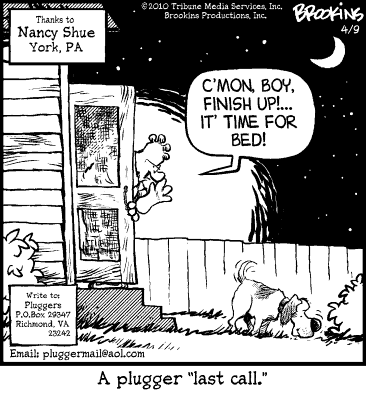
(4/9/2010) Luckily, the comics do not need to worry too much about ethos.
(source: http://www.gocomics.com/pluggers/ -- Yes, I know it's from the web and web examples are not acceptable, but it's too good to pass up.)
Your portfolio should contain ten individual entries presented in a small binder of some sort. Be sure to keep your material well organized. For each entry include the following information:
Identify the source: Include the title of the source (if applicable) and a brief description of it. (Handwritten sources are not acceptable.)
Identify the problem or problems: Briefly describe what drew your attention to the document/source. If there are several problems, you need to only discuss the top two or three attention-getters. Be sure to clearly explain the editing failure(s), the possible causes, and the potential impact of the error on the editor/writer/company (ethos). These explanations must be typed.
Include the source: Include the evidence (document/source). You may use a digital camera to record signs or posters you happen to find and print the picture. You may also make a photocopy of the material, if appropriate.
NOTE: It does not take much energy to find web sites with materials such as I am requesting of you. Therefore, items from web sites are not acceptable for this assignment. All entries must be developed independently for this assignment. You may use only one example from the Signpost. Successful submissions will include samples from varied sources, clear and complete descriptions, and accurate editing identification.
This is not difficult work. If you begin to keep an eye open at the beginning of the semester, you will quickly accumulate far more entries than you need for your portfolio.