History 2710
The Legacy of Reconstruction
Readings:
- Zinn: 9
- Constitutional amendments 13, 14, 15; see also: the powers of Congress to enforce
- Thomas Nast cartoons: http://www.csub.edu/~gsantos/cat15.html
- court case
Discussion:
- How was Reconstruction a "splendid failure"?
- Who is a citizen? What are civil rights? Who is a person? What are inalienable rights?
- What is the legal status of African Americans in 1875? in 1900?
- What strategies did African Americans pursue to gain equity under law during Reconstruction? during the Jim Crow era?
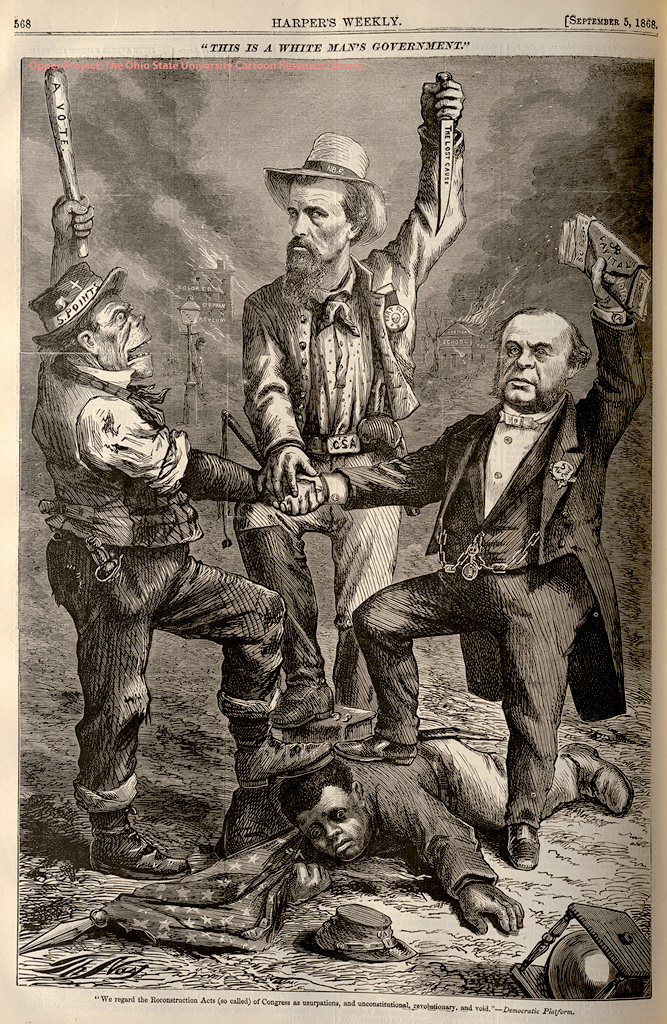 Title: This is a White Man's Government
Artist: Thomas Nast
Date: 1868
http://www.learner.org/biographyofamerica/prog12/feature/index.html
The time period traditionally assigned to Reconstruction is 1865 to 1877. This period began with the onset of an intense national struggle over the shape of society and government in the postwar South; it ended with the collapse of the last Southern state governments under Republican control and the tacit acknowledgment that the federal attempt to remake the South was over.
| 1862 | September 23, Lincoln's Emancipation Proclamation is published, to take effect on January 1, 1863. |
| 1863 | March 3, The Conscription Act (Enrollment Act) is passed, demanding enrollment of males ages 20-45 in the Union Army. Payments of $300 may be used for an exemption. |
| 1863 | June 20, Union West Virginia is admitted as the 35th state - its constitution mandates the gradual emancipation of slaves. |
| 1863 | July 3, Battle of Gettysburg - major Union victory. Over 50,000 casualties total; halts the Southern advance into Union territory and leads to the retreat of Lee's army. |
| 1863 | July 13, New York Draft Riots begin - four days of Irish-American mob action. |
| 1863 | November 19, Lincoln delivers the Gettysburg Address. |
| 1863 | December 8, Lincoln issues the Proclamation of Amnesty and Reconstruction, offering pardons to Confederates who take a loyalty oath. |
| 1864 | September 2, Sherman burns Atlanta and continues his march to the sea. |
| 1865 | February 1, Congress proposes the 13th Amendment, outlawing slavery and involuntary servitude everywhere in the United States. |
| 1865 | March 3, Freedmen's Bureau is founded to aid former slaves |
| 1865 | March 4, Lincoln is inaugurated for his second term with Andrew Johnson as vice-president, pledging "malice toward none, and charity for all." |
| 1865 | April 8, Lee surrenders to Grant at Appomattox, Virginia. |
| 1865 | April 14, Lincoln is assassinated at Ford's Theater by John Wilkes Booth. |
| 1865 | April 18, Johnston surrender to Sherman in North Carolina, effectively ending the Civil War. |
| 1865 | Johnson moves to Reconstruct the South on his own initiative He prefers to call the process "restoration", emphasizing his leniency towards the rebelling Southern states. Former Confederate military leaders and patricians with taxable property over $20,000 are disenfranchised until further notice; only 10% of enfranchised Southern population needs to take an oath of loyalty before readmission. |
| 1865 | Southern states begin to pass "Black Codes" these laws subject former slaves to a variety of restrictions on their freedom: they forbid blacks to testify against whites; they establish vagrancy and apprenticeship laws; blacks cannot serve on juries, bear arms, or hold large meetings. |
| 1865 | The Thirty-ninth Congress convenes It is the first session since Lincoln's death. All Confederates states, with the exception of Mississippi have formally accepted presidential requirements for readmission to the Union and representation in Congress. Led by radical Thaddeus Stevens, the House simply omits the southerners from roll call, effectively denying them admittance. It then proceeds to discuss punishment for the rebellious South which according to Radical Republican Charles Sumner has committed "state suicide." |
| 1865 | The Ku Klux Klan is formed in Tennessee it is one of the many secret societies set up to terrorize blacks. Its methods become ever more vicious as whites become more certain that their old way of life is being threatened. |
| 1866 | Johnson vetoes Freedmen's Bureau bill and Civil Rights Act of 1866; a modified version of the Freedmen's Bureau bill later passes, and Congress overrides Johnson's veto of the Civil Rights Act. |
| 1866 | 14th Amendment passed by Congress grants full citizenship to blacks, gives the Federal government the responsibility to protect equal rights under the law to all American citizens. |
| 1866 | Bloody race riots erupt in Memphis and New Orleans. |
| 1866 | In Congressional elections of 1866, Republicans increase their majority in Congress, forming solid anti-Johnson majorities in both houses. |
| 1867 |
First Reconstruction Act passes over Johnson's veto. Temporarily
places the South under military rule; states may be readmitted if their new
state constitutions provide for black suffrage. Sojourner Truth speaks at First Annual Meeting of the American Equal Rights Association. |
| 1868 | Impeachment Crisis Congress impeaches Johnson but he avoids conviction by one vote. |
| 1868 | Georgia expels blacks from its legislature. Military rule is instantly re-imposed on the state and earlier readmission to representation in Congress is revoked. Ratification of the 14th amendment is now made obligatory before representation in Congress will be allowed. |
| 1868 | Grant is elected President. |
| 1869 | 15th Amendment passed by Congress prohibits any state from denying a citizen the right to vote because of race, color, or previous condition of servitude. |
| 1870 | Force Acts (KKK Acts) passed by Congress seek to enforce 15th Amendment by giving Federal protection for black suffrage, and authorize the use of Federal troops against the KKK. These acts are declared unconstitutional in U.S. v. Cruikshank in 1875. |
| 1872 | Grant wins a second term as President, defeating Horace Greeley. |
| 1873 | Panic of 1873 plunges the nation into a depression. |
| 1874 | Grant uses force for the last time to subvert the White League's attempt to overthrow a Republican government accused of stealing an election. |
| 1875 | Civil Rights Act of 1875 states that no citizen can be denied the equal use of public facilities such as inns, restaurants, etc. on the basis of color. |
| 1876 | Disputed election between Rutherford B. Hayes and Samuel J. Tilden resolved in favor of Republican Hayes. |
| 1877 | Compromise of 1877 results in end to military intervention in the South and the fall of the last radical governments; restores "home rule" in the South |
| 1883
1889 1895 |
Civil Rights Cases strike down the Civil Rights Act of 1875. Congress
may not legislate on civil rights unless a state passes a discriminatory
law; Court declares the 14th Amendment silent on racial discrimination by
private citizens. Frederick Douglass speech given in commemoration of abolition of slavery in the District of Columbia. Booker . Washington advocates compromise |
| 1896 | Plessy
v. Ferguson upholds Louisiana statute requiring "separate but
equal" accommodations on railroads. Court declares that segregation is not
necessarily discrimination. This decision will affirm
Jim Crow
laws in the U.S.
Justice Harlan's dissent argues that segregation is inherently discrimination; this argument will be used to support the majority opinion in Brown vs. Board of Education in 1954. |
| 1898 1903 1905 1909 |
Williams v. Mississippi
upholds a state law requiring a literacy test to qualify for
voting. W.E. B. DuBois, publishes The Souls of Black Folks. The Niagara Movement is organized and denounces Washington's accommodation to segregation. The NAACP is formed in New York City by a group of black and white citizens committed to helping to right social injustices . |
(Source for timeline: http://www.pinzler.com/ushistory/timeline6.html)