History 3210 Summer 2004 MacKay Week Three
A Promise Deferred/ Economic Systems and the Courts
Readings: On Trial, vol. 2: essay 2
we will consider these cases in relationship to Plessy vs. Ferguson:
The Slaughter-House Cases (1873): http://www.lectlaw.com/files/case30.htm
Slaughterhouse Cases, cases decided by the U.S. Supreme Court in 1873. In 1869 the Louisiana legislature granted a 25-year monopoly to a slaughterhouse concern in New Orleans for the stated purpose of protecting the people's health. Other slaughterhouse operators barred from their trade brought suit, principally on the ground that they had been deprived of their property without due process of law in violation of the Fourteenth Amendment. The U.S. Supreme Court, with Justice Samuel F. Miller rendering the majority decision, decided against the slaughterhouse operators, holding that the Fourteenth Amendment had to be considered in light of the original purpose of its framers, i.e., to guarantee the freedom of former black slaves. Although the amendment could not be construed to refer only to black slavery, its scope as originally planned did not include rights such as those in question. A distinction was drawn between United States and state citizenship, and it was held that the amendment did not intend to deprive the state of legal jurisdiction over the civil rights of its citizens. The restraint placed by the Louisiana legislators on the slaughterhouse operators was declared not to deprive them of their property without due process
The Civil Rights Cases (1883): http://www.michaelariens.com/ConLaw/cases/civilrightscases.htm
Question Presented:
Does the Civil Rights Act of 1875 violate the 10th Amendment of the Constitution which reserves all powers not granted to the national government to the states or to the people?Conclusion:
The Fourteenth Amendment restrains only state action. And the fifth section of the Amendment empowers Congress only to enforce the prohibition on state action. The amendment did not authorize national legislation on subjects which are within the domain of the state. Private acts of racial discrimination were simply private wrongs that the national government was powerless to correct
Yick Wo vs. Hopkins (1886): http://usinfo.state.gov/usa/infousa/facts/democrac/64.htm
Cumming vs. School Board of Richmond County, Ga (1893): http://afroamhistory.about.com/library/blcumming_v_richmond.htm
The Supreme Court suggested that it would not be overly scrupulous in guaranteeing that segregated facilities were actually equal. The case was brought by Augusta, Georgia blacks to challenge the school board's decision to close the county's only black high school.
Williams vs. Mississippi (1898): http://www.pbs.org/wnet/jimcrow/stories_events_williams.html
The Supreme Court upheld Mississippi statutes (from the 1890 state constitution) preventing most blacks from voting or serving on juries. These statutes included a poll tax and literacy tests that reduced eligible black voters and jurors to only a few thousand in the entire state. Other states had adopted similar policies: In 1896 there were 130,344 blacks registered to vote in Louisiana; by 1900 the new Louisiana constitution had reduced that number to 5320. Only 3000 black men in Alabama were registered to vote out of the more than 180,000 black men of voting age in 1900. In June 1890 Henry Williams was indicted for murder by a grand jury composed entirely of white men. He contested the indictment, suggesting laws by which the grand jury had been selected were unconstitutional. Williams alleged that these laws were "but a scheme on the part of the framers of that constitution to abridge the suffrage of the colored electors in the state of Mississippi on account of the previous condition of servitude." The case went further to claim that: "the constitutional convention [of 1890] was composed of 134 members, only one of whom was a Negro. That under prior laws there were 190,000 colored voters and 69,000 white voters. The makers of the new constitution arbitrarily refused to submit it to the voters of the state for approval, but ordered it adopted" with election held under the new voting requirements. This state of affairs, it was alleged, made impartial representation on the grand jury impossible.
Justice McKenna delivered the court's opinion:
"it has been uniformly held that the constitution of the United States, as amended, forbids, so far as civil and political rights are concerned, discriminations by the general government or by the states against any citizen because of his race; but it has also been held, in a very recent case, to justify a removal from a state court to a federal court of a cause in which such rights are alleged to be denied, that such denial must be the result of the constitution or laws of the state, not of the administration of them.... the operation of the constitution and laws is not limited by their language or effects to one race. They reach weak and vicious white men as well as weak and vicious black men, and whatever is sinister in their intention, if anything, can be prevented by both races by the exertion of that duty which voluntarily pays taxes and refrains from crime. It cannot be said, therefore, that the denial of the equal protection of the laws arises primarily from the constitution and laws of Mississippi; nor is there any sufficient allegation of an evil and discriminating administration of them.... the constitution of Mississippi and its statutes... do not on their face discriminate between the races, and it has not been shown that their actual administration was evil; only that evil was possible under them.
We will also consider these cases related to gender discrimination:
Bradwell vs. Illinois (1873) : http://usinfo.state.gov/usa/infousa/facts/democrac/62.htm
The U.S. Supreme Court ruled that the Illinois Supreme Court had properly denied Myra Bradwell the right to practice law because she was a woman. Supporting the majority opinion, Justice Joseph P. Bradley observed, "The paramount destiny and mission of woman are to fulfill the noble and benign offices of wife and mother. This is the law of the Creator."
The Susan B. Anthony case (1873): http://www.law.umkc.edu/faculty/projects/ftrials/anthony/sbahome.html
At the election of President and Vice President of the United States, and members of Congress, in November, 1872, Susan B. Anthony, and several other women, offered their votes to the inspectors of election, claiming the right to vote, as among the privileges and immunities secured to them as citizens by the fourteenth amendment to the Constitution of the United States. The inspectors, Jones, Hall, and Marsh, by a majority, decided in favor of receiving the offered votes, against the dissent of Hall, and they were received and deposited in the ballot box. For this act, the women, fourteen in number, were arrested and held to bail, and indictments were found against them severally, under the 19th Section of the Act of Congress of May 30th, 1870, (16 St. at L. 144.) charging them with the offense of "knowingly voting without having a lawful right to vote."
Ex Parte Lockwood: http://caselaw.lp.findlaw.com/scripts/getcase.pl?court=us&vol=154&invol=116
Belva Ann Lockwood was born in New York in 1830. After leaving college she became a school teacher. Later she joined the campaign to obtain equal pay for women teachers. A member of the American Woman Suffrage Association. Lockwood moved to Washington in 1866 and played a major role in persuading Congress to pass the 1872 bill guaranteeing female government employees equal pay for equal work. In1872 Lockwood joined the Equal Rights Party Although laws prohibited women from voting, there was nothing stopping women from running for office and Victoria Woodhull became the party's presidential candidate. During the campaign Woodhull called for the "reform of political and social abuses; the emancipation of labor, and the enfranchisement of women. Woodhull also argued in favor of improved civil rights and the abolition of capital punishment. These policies gained her the support of socialists, trade unionists and women suffragists. However, conservative leaders of the American Woman Suffrage Association, such as Susan Anthony and Elizabeth Cady Stanton, were shocked by some of her more extreme ideas and supported Horace Greeley in the election. Lockwood now decided to become a lawyer and studied at the District of Columbia law school. She obtained her degree but was barred from practice in the Court of Claims and the United States Supreme Court. In 1873 a judge ruled that could not work as a lawyer in Maryland. He told her: "Women are not needed in the courts. Their place is in the home to wait upon their husbands, to bring up the children, to cook the meals, make beds, polish pans and dust furniture. "
In 1876 Lockwood drafted a bill which would permit women to practice before the United States Supreme Court. It took her three years to persuade Congress to pass the bill and in 1879 became the first woman to be admitted to practice before the nation's highest tribunal. In 1884 Lockwood became Equal Rights Party presidential candidate. Her campaign created a great deal of hostility and she only won 4,149 votes and was easily beaten by Grover Cleveland(4,874,986), James Blaine(4,851,981), and John St. John(150,369). For the rest of her life Lockwood continued to campaign for women's rights and international peace. She successfully campaigned for women to have equal property rights in the District of Columbia and established the International Peace Bureau. Belva Ann Lockwood died in 1917.
Economic Systems and the Courts
We will consider two eras: Progressive Reform and New Deal Reform
Progressive Reform
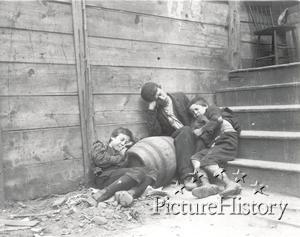 Street Arabs in Sleeping Quarters
This photograph by Jacob Riis shows young boys
sleeping in the streets of New York City.
Readings: On Trial, vol. 2, essays: 4, 5, 6
We will consider cases:
Wabash, St. Louis & Pacific Railroad v. Illinois (1887): http://intranet.rutgers.edu/~clemens/WABASH.html
The Supreme Court reversed its position initially put forth in Munn v. Illinois, by holding that Illinois legislation enacted to regulate railroad rates interfered with the Congress's ability to exercise its authority over interstate commerce. This decision ended the brief era of state railroad regulation. Congress passed the Interstate Commerce Act in 1887.
Lochner v. New York ( 1905): http://www.michaelariens.com/ConLaw/cases/lochner.htm
Muller v. Oregon (1908): http://www.michaelariens.com/ConLaw/cases/muller.htm
Adkins v. Children's Hospital (1923): http://caselaw.lp.findlaw.com/cgi-bin/getcase.pl?court=us&vol=261&invol=525
Invalidated, as infringing upon the 5th Amendment, an act of Congress (1918) authorizing the Wage Board for the District of Columbia to fix minimum wages for women. The Court found that upholding the statute would dangerously extend the police power of the state and, thus, found it unconstitutional. Justice Sutherland recognized that the freedom of individuals to make contracts is not absolute and curtailments of this right may be justified in the face of "exceptional circumstances." However, in this case, the statute's implementation procedures were overly vague and did not act to regulate the character or method of wage payments, or the conditions and hours of labor, areas in which regulation to protect the public welfare were legitimate. The Congress simply had enacted a "price-fixing law."
In dissent Justice Holmes stated: “the criterion of constitutionality is not whether we believe the law to be for the public good.” In 1918 the U.S. Congress had authorized the Wage Board to ascertain and fix adequate wages for women employees in the nation's capital. In their ruling on this case, the Supreme Court cast a 5-3 vote that the law authorizing the Wage Board infringed upon Fifth Amendment guarantees of life, liberty, and property. Employer and employee, according to the majority opinion, had a constitutional right to contract in whatever manner they pleased. Thus, the establishment of the Wage Board was an unjustified interference with the freedom of contract. In their dissent, justices William Howard Taft, Oliver Wendell Holmes, Jr., and Edward T. Sanford argued that Congress had the policing power to correct recognizable evils. In 1937, the Supreme Court overturned Adkins v. Children's Hospital in West Coast Hotel Company v. Parrish, ruling that some government intervention in contracts between employers and employees is not unconstitutional.
And the 4 Progressive Amendments to the Constitution:
16th Income Tax
17th Direct Election of Senators
18th Prohibition See also: http://arcweb.sos.state.or.us/50th/prohibition1/prohibintro.html19th Woman Suffrage See also:
http://www.nara.gov/education/teaching/woman/home.html
Progressives themselves were never a unified group seeking a single objective or a single set of objectives. They had many different, even contradictory goals, including:
- End to "white slavery" (prostitution and the sweat shops)
- Prohibition
- "Americanization" of immigrants
- Immigration restriction legislation
- Anti-trust legislation
- Rate regulation of private utilities
- Full government ownership of private utilities
- Women's suffrage
- End to child labor
- Destruction of urban political machines
- "Taylorism"
- Political reform
There were four basic types of Progressive reform:
Economic--"Monopoly"
Structural and Political--"Efficiency"
Social--"Democracy"
Moral--"Purity"Even though they were not a unified group, Progressives shared five basic characteristics or beliefs:
- Moralists
- Government, once purified, must act
- Weakest element of society must be protected
- Never challenged capitalism's basic tenets
- Paternalistic, moderate
Progressive Reformers include:
Jane Addams
Robert La Follette
Florence Kelley
Ida Tarbell
Upton Sinclair
Ida B. Wells-BarnettInternet Resources
From the U.S. State Department Outline of American History, summaries of issues and events during Gilded Age and Progressive Era: http://usinfo.state.gov/products/pubs/history/ch8.htm
Consider the Illustrations in: Jacob Riis, How the Other Half Lives: http://www.yale.edu/amstud/inforev/riis/title.html
From the American Memory project of the Library of Congress are good summaries and links for "Work in the Late 19th Century": http://memory.loc.gov/ammem/ndlpedu/features/timeline/riseind/work/work.html
and for the Progressive Era: http://memory.loc.gov/ammem/ndlpedu/features/timeline/progress/progress.html
Additional information about the gap between the rich and the poor in the 1890s
The New Deal faced a lot of opposition from the Supreme Court. The Supreme Court in 1935 it effectively declared the National Recovery Administration (NRA) illegal. In the following year it declared the Agricultural Adjustment Act (AAA) unconstitutional thus killing off the AAA. The point made by the Supreme Court was that any efforts made to help farmers etc. should come at a state level and not federal level and that these parts of the New Deal went against the powers given to the states by the Constitution.
Beginning in January, 1935, the Supreme Court began to nullify major acts. In the next sixteen months, 10 major cases came before the court. "In eight instances the decision went against the New Deal. Stricken down in succession were Section 9(c) of the National Industrial Recovery Act, the N.R.A. itself, the Railroad Pension Act, the Farm Mortgage law, the Agricultural Adjustment Act, the A.A.A. amendments, the Bituminous Coal Act, and the Municipal Bankruptcy Act." Of the acts challenged all the way to the Supreme Court, only the monetary acts of 1933 and TVA had survived. Eventually eleven out of 16 of the Alphabet Laws were decreed unconstitutional in cases heard by the Supreme Court. The argument of the Supreme Court was that Roosevelt had tried to impose the power of the federal government on state governments – and this was unconstitutional. If a state deemed that there was a crisis is farming then it had the right to tackle this crisis as laid down by the Constitution but the federal government did not have the right to impose its decisions onto states.
We will consider cases:
Schechter Poultry Corp. v. United States (1935): http://www.michaelariens.com/ConLaw/cases/schechter.htm
Facts of the Case:
Section 3 of the National Industrial Recovery Act empowered the President to implement industrial codes to regulate weekly employment hours, wages, and minimum ages of employees. The codes had standing as penal statutes. Question Presented:
Did Congress unconstitutionally delegate legislative power to the President? Conclusion:
The Court held that Section 3 was "without precedent" and violated the Constitution. The law did not establish rules or standards to evaluate industrial activity. In other words, it did not make codes, but simply empowered the President to do so. A unanimous Court found this to be an unconstitutional delegation of legislative authority.
West Coast Hotel Co. v. Parrish, et al. (1937): http://plaza.ufl.edu/edale/WEST%20COAST%20HOTEL%20CO.htm
Washington statute required minimum wage for women. Opponents argued it violated their freedom of contract with women. Court upheld statute and overruled Adkins.
Summary of New Deal legislation
for a history of the minimum wage law (federal law passed 1938): http://www.ebri.org/facts/0498afact.htm
Young Oklahoma mother, age 18, penniless, stranded in Imperial Valley, Ca. March, 1937. Photograph by Dorothea Lange.
Internet Resources
Photographs of the Great Depression: http://memory.loc.gov/ammem/fsowhome.html
Economic Systems Defined
(from AmosWEB: http://www.amosweb.com/gls)
Corporation: One of the three basic forms of business organization (the other two are proprietorship and partnership). A corporation is a business established through ownership shares (termed corporate stock). Since Supreme Court rulings in the 1870s, A corporation is considered a distinct legal person, that can be sued, forced to pay taxes, etc., just like a human person. Unlike proprietorships and partnerships businesses, a corporation business exists separately from its owners. As such, the owners have what lawyer-types term limited liability. Owners can not be held personally responsible for corporate debts. The owners can only lose the value of their ownership shares, but no more.
Consumption: The use of
resources, goods, or services to satisfy wants and needs. At the microeconomic
level, consumption is primarily analyzed in the context of utility, demand and
their importance to market exchanges. At the macroeconomic level, consumption is
most important as expenditures by the household sector on gross domestic
product, one of four aggregate expenditures (the other three being
investment, government purchases, and net exports).
Socialism develops in the 19th century as a critique of capitalism -advocates a system of collective or government ownership and management of the means of production and distribution of goods. Because of the collective nature of socialism, it is to be contrasted to the doctrine of the sanctity of private property that characterizes capitalism. Where capitalism stresses competition and profit, socialism calls for cooperation and social service. In a broader sense, the term socialism is often used loosely to describe economic theories ranging from those that hold that only certain public utilities and natural resources should be owned by the state to those holding that the state should assume responsibility for all economic planning and direction.
Centrally Planned Socialism
This economy is described in terms of public ownership of resources, where resources are allocation decisions are made through a central planning board. Production practices are under very strict control, and business establishments are government (public) owned and produce under state directives. Political and legal institutions (policies established by the central planning board) and social institutions (social norms, traditions, etc.) dictate producer and consumer behavior.
Mixed Economy (Capitalism with Socialist Institutions)
In this type of economy, which we have in the United States of America, either the private sector (households or businesses) or the public sector (government) can own resources. Markets for goods and services do exist, some of which are regulated. Governmental economic policies are designed to promote economic stability and encourage economic growth. Government provides goods that would be under produced or not produced at all under a market system, such as highways, national defense, law enforcement, etc. Economic, social, political and legal institutions influence producer and consumer behavior.
The traditional American Dream once focused on greater security, opportunity and happiness. Increasingly, that dream has been supplanted by an extraordinary emphasis on acquisition. The recent commercial definition of the American Dream has hidden costs for the environment, our quality of life, and our efforts to create a just and equitable society.
Additional information with Internet resources is available for:
"Are We Still and Middle-Class Nation?" by Michael Lind http://www.theatlantic.com/issues/2004/01/lind.htm